Abstract
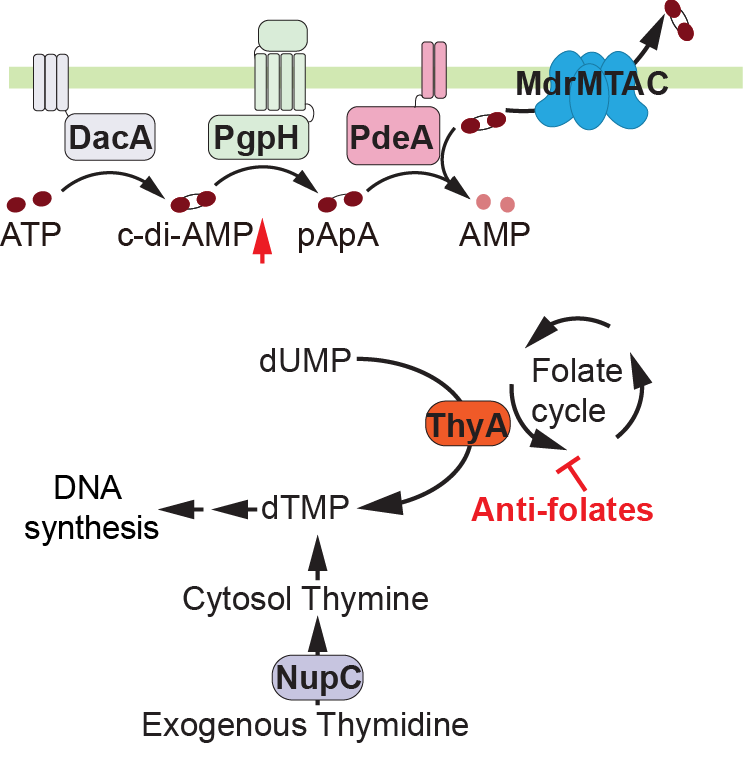
Antifolate antibiotics are used to treat meningitis and refractory listeriosis caused by drug-resistant Listeria monocytogenes (Lm). Their bactericidal activity is attributed to the deactivation of thymidylate synthase (ThyA), which subsequently induces bacterial cell death when thymidine is depleted, a process known as thymineless death (TLD). Despite decades of study, the mechanisms of TLD, especially during infection, remain unclear. Cyclic di-AMP (c-di-AMP), a common bacterial second messenger that regulates bacterial stress responses, is elevated in response to antifolate antibiotics. In this study, we found that elevated c-di-AMP is required to inhibit TLD in Lm. Conversely, reducing c-di-AMP levels in the ΔthyA mutant led to increased bacterial cell death under thymidine starvation and significant reduction in intracellular growth. Furthermore, we found that ΔthyA exhibited a more pronounced growth defect during oral infection compared to intravenous infection, due to limited thymidine availability in the gallbladder, which acts as a bottleneck for ΔthyA in establishing infection. Notably, decreasing c-di-AMP levels abolished the infection capacity of ΔthyA in both infection models. Finally, we identified that the c-di-AMP-binding protein PstA contributes to bacterial cell death when c-di-AMP concentrations are low. Deletion of pstA in the ΔthyA background rescued the elevated cell death caused by c-di-AMP depletion both in vitro and during mouse infections. Our study identifies a previously unrecognized mechanism of TLD regulation mediated by c-di-AMP. This expands fundamental knowledge of TLD in the context of infection and provides insight into potential combined therapeutic strategies for listeriosis targeting both antifolate and c-di-AMP metabolic pathways.